In the history of our culture there is probably no other piece of literature that has been reworked by so many committees of duplicitous connivers and translated and re-translated by so many generations of scribes, each with his own cultural baggage and political agenda.
The Book is the product of a very reiterative process and what we get in the end is the result of accretion and deletion, acts both deliberate and unintentional, the secret insertion of subtexts, the adoption of local myth, cultural appropriation, acts motivated by politics, ignorance, faith or higher knowledge, perpetrated by the power hungry as well as the altruistic.
Just look at the multitude of variations of faith in the Children of Abraham, each one is the only true way and no two are alike. Multiply this by the factor that many of these people say one thing, believe another and act without regard to either.
This is because there are various, sometimes contradictory meanings, coded into the text at different scales, using self reference, foreshadowing, double entendre, symbolism, and even Kabbalistic and numerological ciphers.
The Bible is a mythical map for an ever changing cultural terrain. Maybe the lesson to be learned from studying the Bible is that many forms of Order can be derived from Chaos, but these forms are projected by the observer based on there position in space and time.
I like to attribute my cynicism to an early childhood servitude to the Church and the subsequent betrayal, which left me with instinctual guilt and self doubt. These are useful tools for a skeptic, but just as having the proverbial hammer makes every problem look like a nail, so too doubt is better for building walls than windows.
I am working on writing up my ideas about chaos theory as applied to religion and, while it was easy for me to point out the role of uncertainty and the danger of faith in science, it pains me to put into words what seems antithetical to religion: that there is no absolute truth to be had.
I may be a bit more sensitive to the feelings of the faithful than your average atheist, but I would still never recommend that anyone should actually adhere to someone else's religion. Make one up for yourself maybe, and never take it too seriously, but don't ever buy one of those off the shelf models. Here's why:
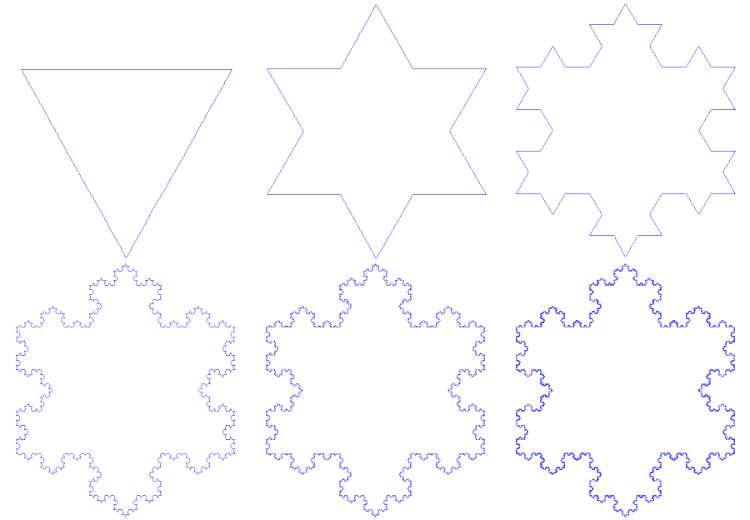
One of the aesthetics suggested by chaos theory is the property of fractals to display self similarity at different scales, as demonstrated by zooming in on the mini-Mandelbrots in the Mandelbrot set.
Another is their fractional dimensionality. Unlike euclidean geometrical shapes fractals have borders of infinite complexity which interpenetrate their surroundings.
Applied to nature, these concepts are much more useful than linear measures for understanding phenomenon like clouds and turbulence. It is easy for casual observer to see the similarity of clouds or ripples of different sizes, or at various distances and magnifications. As well, anyone can see the lack of real borders between the clouds and the air, or between a whirlpool and the water.
If we look at human existence in this way, we will see that humans (and other living things) are also like this. Since we shed all our cellular material over a seven year period and new material is absorbed from our surroundings through the convoluted interfaces of our skin, lungs and digestive systems; we are more like a vortex moving through a medium than we are like a solid object. We dissipate through time; chances are you are occupying an entirely different physical body than the one you originally used to log onto the Internet that very first time, all those years ago, yet somehow there is a continuity of consciousness even though you think and feel different.
As such, we are similar to and yet different from each other, from our former "selves" and from our ancestors and evolutionary predecessors. The physical borders between our "selves" and the environment are indistinct, permeable and variable.
I have digressed, but my point is that I would like to apply these ways of looking at things to the subject of religion. The clip below demonstrates the property of self similarity in religion. We can see that figures such as Jesus and Moses are not unique occurrences in time but reiterations of a historical formula. And so truth in religion can not be absolute, but will tend to recur, self-similarly (like a self-fulfilling prophesy), in myths, social and family structures, and personal development - right down to WWJD (what would Jesus do) today.
I highly recommend you watch the whole movie. Zeitgeist is available in 13 parts on YouTube. I definitely want to write more about it here, as the producers present some thought provoking ideas about the social structures used to control the masses and promote the New World Order.
New version has 'fountain of crown'
-
There's a new Psiche post on the new version of the blog!
http://www.palyne.com/blog.psiche/the-fountain-of-crown/
Don't forget this blog has changed addres...
Lucid Dreaming
-
It must be something about the way my brain came wired.
As a child, I lucid dreamed chronically. And at will. I could drop myself
into a 'day'-dream if I c...
As the world becomes more complex it becomes increasingly difficult to predict what will happen next. This can be disconcerting to people who are raised to expect "order and good government". In fact this "new world (dis)order" is closer in its behavior to natural systems such as biosphere than it is to the orderly machinations we associate with civilization. A study of this kind of chaos reveals it to be the manifestation of a higher order. Although culturally bogged down in linear thinking left over from the now outdated Newtonian "Enlightenment", science, the arts, even religion can provide us with the tools to understand, and benefit from this emerging order. I believe that to adhere to unchanging linear models is to have a fossilized mind. To avoid extinction we must be prepared to co-evolve with our technologies. This site is dedicated to that process. Your comments and observations are welcome on the blog. As a first principle I recognize that no paradigm can claim the ultimate ontology and so we will abide by physicist/philosopher David Bohm's principles of "scientific irony". By this I mean that there is no one truth and and I take everything with a grain of salt.